This is a slightly abbreviated version of a talk I gave in our congregation yesterday evening.
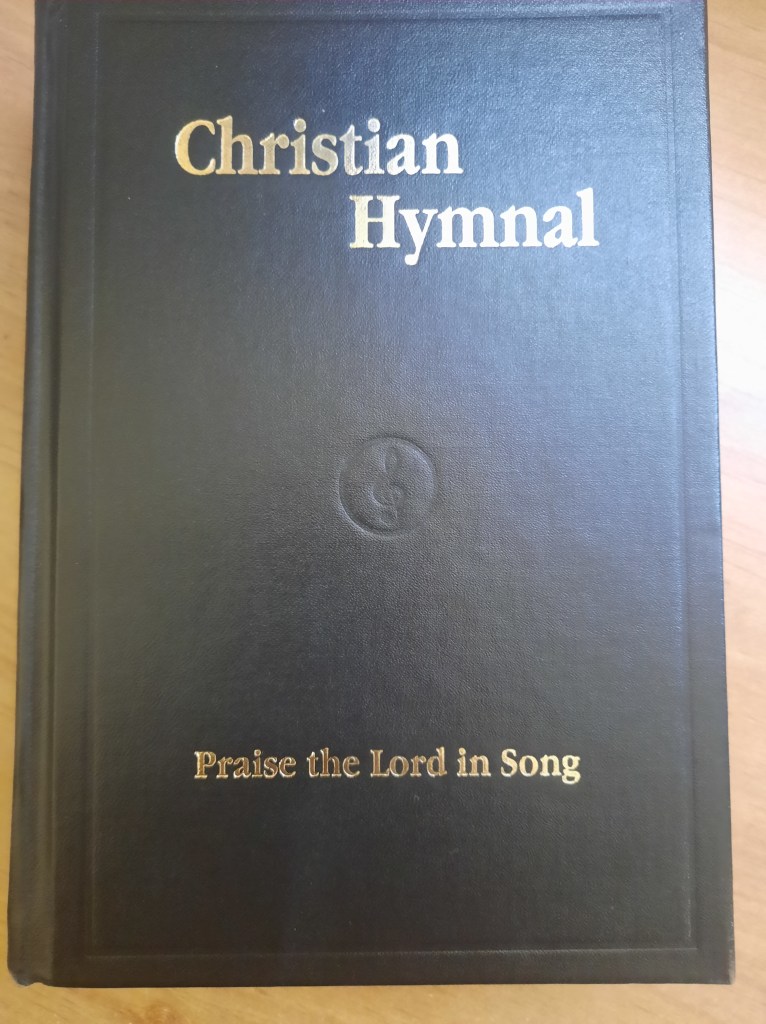
The Christian Hymnal that we find in our pews was first printed in 1959 and to date 392,000 copies have been printed. About half of these are sold to congregations and individuals of other denominations. If hymnals in congregational use last 20 – 25 years, 30 at the most, congregations which existed when the Christian Hymnal first came out are probably on their third set of books.
The question of having our own English hymnal first came up at the 1933 Conference. The decision then was that we were not in a position to proceed.
The question came up again at the 1942 Conference and this time the decision was positive. A committee of seven brethren, a mix of ministers and song leaders, was chosen for compiling this book. When the committee first met each member brought his favourite hymns. When they invited the church membership to send their favourites, another 1500 came in. These were sung again and again, and the selection slowly pared down. The songs came from many different publishers, without the quality of typesetting and printing we have today. The committee thought it best to make them uniform, and change all the hymns that weren’t already in shaped notes. At that time there were no photocopiers or computers available to them, so how did they do it? One brother in the committee did it by cutting out the notes and then setting up the song, note by note, with tweezers and glue.
The secretary spent years in correspondence getting permission from copyright owners of the songs to be used. Permission was not always granted. In 1952, the first copies of The Christian Hymnal were printed. It included some children’s songs and My Country ‘Tis of Thee. Sad to say, it turned out to be a poor quality book. Some members of the committee wept when they saw it. After the war, good paper was hard to come by, and funds were limited. The printing was not uniform; some pages were light, and others ink soaked into the paper. However, in spite of the imperfections, it proved to be a blessing to the church. There were two printings made of that first hymnal, but no record has been found of the number printed.
The 1956 Conference passed a resolution to make a revised edition of The Christian Hymnal. This was to be a larger size and printed by a different company, if necessary. A committee of ten men was chosen for this work. The new committee contained no ministers, only singers.
Once again these men applied themselves to the work, which took about two years. All the meetings were held around the dining room table in the Kansas homes of Adin Holdeman, Reuben Buller and Alvin Becker. They would meet for a week at a time, staying several days at each place. The lady of the house cooked the meals, served snacks, and lots of coffee, which might be the reason for rotating between homes.
Before each meeting they prayed for wisdom and guidance as they decided which songs to put in the book. One of the gravest concerns was to have only songs sound in doctrine. It was a concern shared by all, and there were testimonies of how God gave inspiration to approve, alter, or reject a song on this point. Other concerns were that the songs be easy to sing, have simple harmony, and not be unnecessarily repetitious. They were not to cater to the itching of the ear, but to the needs of the soul.
They went through every song, sang every song, discussed and voted on every song. One source says a 90% vote of the 10 man committee was required to accept or delete a song. The committee endeavoured to select a wide range of songs involving the whole of life; making it suitable for all occasions of worship in the church.
Getting copyrights was time consuming. The Old Rugged Cross, was the most costly in royalties. The committee wanted to put How Great Thou Art into the hymnal, but the copyright would not be granted. At that time it was only in sheet music, not in any book.
In 1959 the revised Christian Hymnal became reality. The first book had been entitled The Christian Hymnal; the revision dropped The from the title. Of the 629 songs in the first book, 118 were deleted in the second and other songs were added. Nineteen of the deleted songs were children’s songs that became the basis of a new book, Silver Gems, first published in 1961.
Over the years, contact was lost with some copyright owners. The Internet made it possible to find these lost owners. Around 2005, a tidy sum of back royalties was made to them.
After the first printing the committee decided to put scriptures under the song titles, which became Henry Friesen’s responsibility. He was also the proofreader, diligently scanning through each new printing of the hymnal for errors. He kept finding some in every printing as long as he was responsible.
The oldest song in the hymnal is N° 610, Jerusalem My Happy Home, written in Latin in 430 AD. Hymn writing in English began with Isaac Watts, who was born in 1674 and died in 1748. Prior to his time, English churches of all denominations sang only the Psalms put into rhyming form and set to music. One day in his youth, Isaac Watts asked his father why there were no hymns written since the time of David. His father challenged him to write some, so he did, 750 of them in his lifetime. That began an explosion of hymn writing in England.
Most of the older hymns in the Christian Hymnal come from England. Other hymns come from American writers, a few from Canadian writers, a few have been translated from German. There are at least three from black writers. N° 296, Where Shall I Be, is an arrangement of an old Spiritual. N° 468, Leave it There, and N° 608, The Unclouded Day, were written by two different black ministers, who wrote both the words and the music.
French hymn writing began much earlier, in John Calvin’s church in Geneva in the mid 1500’s. A hymn book was published there in 1561. Because of the differences in the structure and rhythm of the languages it is very difficult to translate a hymn from French to English, or English to French, and make it fit the same melody. There are four hymns in the Christian Hymnal set to one melody by Louis Bourgeois from that 1561 hymnal. In two of them, N° 11, Praise God From Whom All Blessings Flow and N° 19, Ye Nations Round the Earth, the words appear to be modelled after the original French words of Louis Bourgeois. Another prolific French hymn writer was César Malan who died in 1860. The Christian Hymnal has two hymns set to one of his melodies, N° 53, Lord We Come Before Thee Now and N° 485, To Thy Pastures Fair and Large.
Hymn N° 257, The River of Life, puzzled me for years. The notation in the Christian Hymnal says it was written in English by Elizabeth Codner, translated to German by Ernst Gebhart, then translated to English by John D. Warkentin. If it was originally written in English, why did it need to be translated back into English? Well, if you search for hymns written by Elizabeth Codner, you will never find this one. Apparently an error was made when the German version was printed. The original English song does exist, it was written by Richard Torrey, Jr. and published in Boston in 1864 with the same melody that is now used.
I would like to put in a personal plea that N° 356 Abide with Me, Fast Falls the Eventide would be sung more often. We have two Abide With Me hymns in the Christian Hymnal. The one that is a favourite for many of us is not known by the folks in seniors homes. Like most Canadians, they are polite, don’t complain, but that doesn’t mean they’re not disappointed when they ask for Abide With Me and we sing the wrong one. N° 368, Abide with Me, I Need Thee Every Day appears in only a few hymnals and seems to mostly be known by Mennonite groups. N° 356, Abide with Me, Fast Falls the Eventide is far better known, has appeared in the majority of hymn books published in the past 150 years. The copyright expired 100 years ago. Why don’t we make a bunch of photocopies and sing it when we visit seniors homes? Let’s sing their favourite, instead of our favourite, the folks will appreciate it. If we consider the words, it is evident why this hymn touches the hearts of those who know the time remaining to them may be short.
 Flatlander Faith
Thanks very much for that history lesson.
Was the 1952 edition green? I think I have one from my grandfather. I will have to dig it out and take a look.
I saw the 1952 CH once in my life, many years ago, and all I can remember is that the pages were smaller.