This article focuses on the people calling themselves Mennonite who came to Manitoba from Ukraine in the 1870s and later. Lest anyone think I am engaging in an ethnic slur, let me say at the start that my mother was of those people and I will be sharing some of the things she told me.
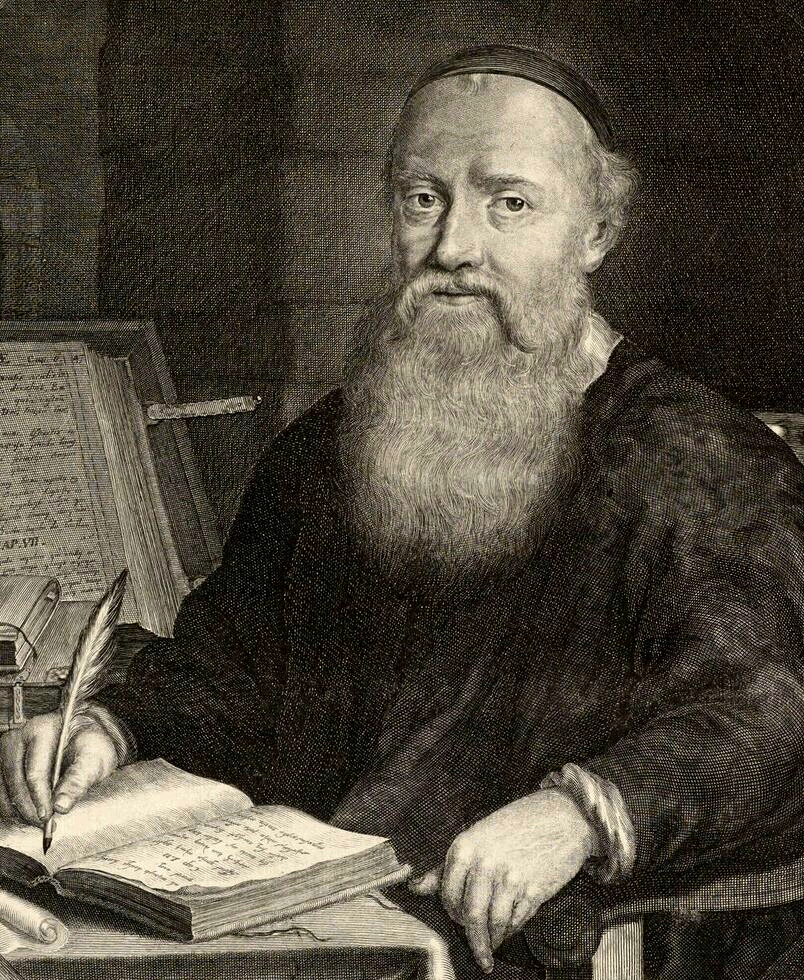
During the persecutions of the 16th century many Flemish and Frisian Mennonites, Menno Simons among them, found refuge in areas near Danzig in northern Germany. Over the following centuries they adopted the German language spoken by those around them. At first, they maintained the vitality and fervour of their faith and others of that area were converted and became part of the Mennonite faith, people with names like Thiessen, Toews, Sawatzky, Schapansky, Letkeman, etc. Letkeman was my mother’s maiden name and the family can be traced back to Jacob Lindtkeman, born before 1685, who joined the Mennonites in Prussia.
The good times did not last. The generation of noblemen who had welcomed the Mennonites on to their estates passed on and their descendents were less and less accommodating. The reaction of the Mennonites was to become the “Quiet in the Land”. They may not have used that slogan yet in Prussia, but that is what they did. They ran up the white flag of surrender and said, “We’ll stop talking to others about our faith if you will allow us to live in peace.”
That bought them some more years of tolerance, as they were no longer a threat to the state churches. Sadly though, once one stops talking about his faith it is just a short step to not having a faith to talk about. Living conditions still became more and more difficult in Prussia, but then events in Ukraine seemed to offer a ray of hope.

Princess Sophie Friederike Auguste von Anhalt-Zerbst-Dornburg was born in Prussia in 1729. Her family groomed her for a royal career and at the age of 16 she married Peter, son of Empress Elizabeth of Russia. He was a weak and immature man but Princess Sophie saw him as the ticket to achieve her destiny. She set herself to learning the Russian language, converted from Lutheranism to the Orthodox church and in the process changed her name to Catherine. Elizabeth died in January of 1762, making Catherine’s husband Tsar Peter II. In July of the same year, Catherine, in league with friends in the military and nobility, overthrew him and had him imprisoned. He died there a week later and Catherine was crowned as Empress Catherine II of Russia. (The Russian and Ukrainian people never called her Catherine the Great.)
During the first years of her reign, Catherine extended the borders of the Russian Empire by some 520,000 square kilometres, seizing Ukraine and other territories from the Ottoman Turks and from Poland. Much of this land was not being farmed, due to years of strife. In 1763 Catherine issued a manifesto inviting foreigners to come and develop these regions. The manifesto promised freedom from military service and the free practice of their religion, except that they were not permitted to proselytize members of the Orthodox church.
Although the manifesto was for all foreigners, the representatives sent out by Catherine to promote the invitation went to areas of German people (remember that Catherine was German). Large numbers of Germans accepted the invitation, principally Lutherans, but also Roman Catholics and Mennonites. If being German was what it took to find a home in Catherine’s Russia, the Mennonites were happy to identify as Germans. In the end, about 20% of those settling in German colonies in Ukraine and other parts of Russia were Mennonites.
By this time, the Mennonites had totally lost their evangelical fervour and it seemingly never entered their minds that they might have something to share with their German neighbours in Russia. But there were groups of Pietists among the Lutherans who were not lacking in evangelical fervour and they had a considerable impact on the Mennonite colonies, as I will describe in my next post.
 Flatlander Faith